
Frequency, Period, Wavelength, Wavenumber, and the Colors of the World Cup
Ten days ago, the World Cup ended, and with the disappointment that all the teams I liked were eliminated almost in the first round, we are going to use a football analogy to better understand periodic phenomena and their fundamental properties: frequency, period, wavelength, and wavenumber. Afterwards, we will use these properties to answer the following question: what is color?
Let's get started and imagine a stadium like Maracanã packed with people enjoying the football. Suddenly, a group of fans from one of the ends starts doing the mexican wave:
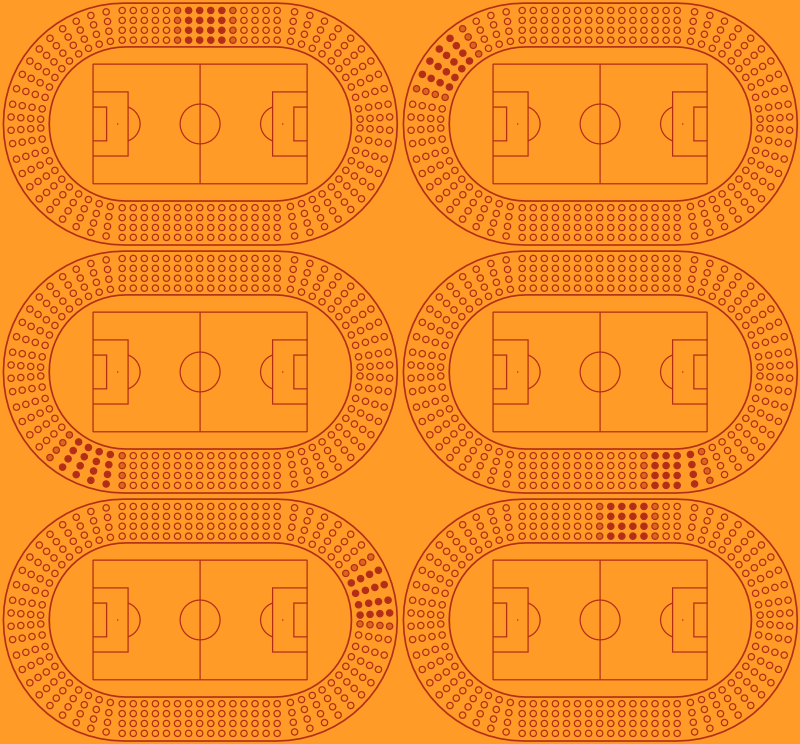
As the game is exciting, the wave goes round and round without stopping, becoming a periodic phenomenon, because you will regularly have to stand up if you are in that stadium.
But how can we describe the wave? You know that the scientific method requires us to quantify what we are going to study as precisely as possible. So, what measurable properties can a wave have? Like any periodic phenomenon, the wave can have frequency, period, wavelength, wavenumber, and speed.
The concept of speed is the most immediate: the wave can go faster or slower. The other four remaining properties are divided into two categories according to the physical magnitude they depend on: time, period, and frequency; or space, wavelength, and wavenumber. Let's see in detail what each one means:
Period: It is the time it takes for a periodic phenomenon to repeat itself (the name says it all). In the stadium, it is the time that elapses from when you have stood up until it is your turn to stand up again. In the International System of Units, it is measured in seconds, but it is generally measured in the unit of time that is most practical. Famous periods are the time it takes for the Earth to revolve around the sun, 1 year, or how often an employee receives their salary, every month or every week.
Frequency: Unlike the period, which is a time, frequency is a quantity. It is the number of times a periodic phenomenon repeats per unit of time. If we choose the minute as the unit of time, the frequency of our wave will be the number of laps the wave makes per minute, or the number of times you have had to stand up each minute. Note that the frequency, \(\nu\) is the inverse of the period, \(T\):
$$\nu = \frac{1}{T}$$
And if the wave takes 30 seconds to go around the stadium, then the frequency with which we stand up is 2 times per minute. How is this phrase "times per minute" expressed in units? Times has no units, and the per in per minute means that the minute is dividing, so the unit of our frequency is:
$$ \frac{1}{\text{min}}$$
although to simplify, using the properties of powers, we usually write it as follows: min-1. This is read as "reciprocal minutes," although many people say "minutes to the minus one." Note again that this unit satisfies the equation that defined the frequency.
In the International System of Units, frequency is measured in hertz, which is the name given to the reciprocal second in honor of Heinrich Rudolf Hertz, the discoverer of a periodic phenomenon that we will see later: electromagnetic waves. The abbreviation for hertz is Hz (remember that all abbreviations of units that come from a famous person's name are written in capital letters, while the rest are in lowercase).
Wavelength: It is the distance that separates a certain point of a periodic phenomenon from the next point with the same characteristics. In our football wave, the point we can choose is that of the people standing up, so its wavelength is what the perimeter of the stadium measures (more or less, since for those who are closer to the pitch, the distance will be less) since there is only one wave in the stadium and the next person standing up in the same way, the same point, is the same person.
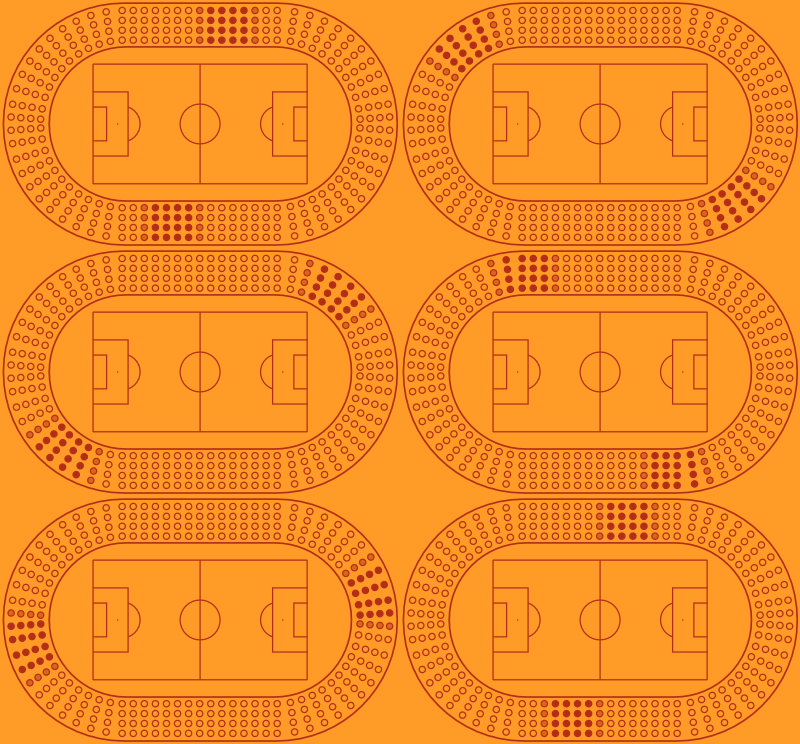
If there were two waves in the stadium, the wavelength would be the distance between two standing guys, that is, half the perimeter of the enclosure. The International System unit for wavelength is the meter.
Wavenumber: It is the number of times a periodic phenomenon repeats per unit of distance. It is the property equivalent to frequency using space instead of time. Analogously, it is important to remember that it does not have units of distance, but rather it is a quantity. In our World Cup example, we will use the unit of distance recently defined by me "stadium" which is equivalent to the distance that the perimeter of the stadium measures. In this way, our wave will have a wavenumber of 1 "stadium to the minus one" or "reciprocal stadium", since the formula is also equal to that of frequency:
$$\tilde{\nu} = \frac{1}{\lambda}$$
where \(\tilde{\nu}\) (the Greek letter nu with a tilde) is the wavenumber and \(\lambda\) is the wavelength. In the double wave example, the wavenumber is 2 st-1, right?
The wavenumber, in the International System, is measured in m-1, reciprocal meters. Although generally the most used unit in spectroscopy (which is where the wavenumber is most used) is the reciprocal centimeter, cm-1. A curiosity: the reciprocal centimeter is also called kaiser in honor of the physicist Heinrich Kayser, but almost no one calls it that because very few remember who that German guy was today.
Relationship between the properties: What is the relationship between the properties that depend on time and those that depend on distance? For example, what is the relationship between period and wavelength? Imagine you are sitting in the stadium and someone starts a wave. Since there is only a single wave on the football field, the wavelength is equal to the perimeter of the field, and since this cannot change, what does the period then depend on? That is, what does the time that passes from when you stand up once until you stand up the next time depend on? It only depends on one thing: on the speed, (v), that the wave has. The faster it goes, the less time will pass between standing up and standing up, or what is the same, the more frequent the standing ups will be:
$$v= \frac{\lambda}{T} = \lambda \nu$$
If instead of using wavelength in the previous equations we had used wavenumber:
$$v = \frac{1}{\tilde{\nu}T} = \frac{nu}{\tilde{nu}}$$
What is color?

The properties we have seen previously are related to colors, since light behaves like a wave, the periodic phenomenon par excellence, and these properties allow us to better understand its nature. A wave is a disturbance in a substance or field that propagates through this substance or field. If we throw a stone into a pond, we will generate circular waves that will emerge from the point where the stone fell and will be transmitted across the surface of the water. When we speak, we generate waves in the air which, unlike the waves on the surface of the water, are transmitted in the three directions of space and which we hear when they reach our ear and make the eardrum vibrate. The eardrum transforms the vibrations into nerve signals that the brain interprets as sound. Since sound waves need a medium to propagate, in the vacuum of space there is only silence, and that is why all movies of battles between spaceships with explosion sounds and so on are incorrect. An individual wave (and one-dimensional, like the one we can obtain by shaking a rope) has a sinusoidal shape:
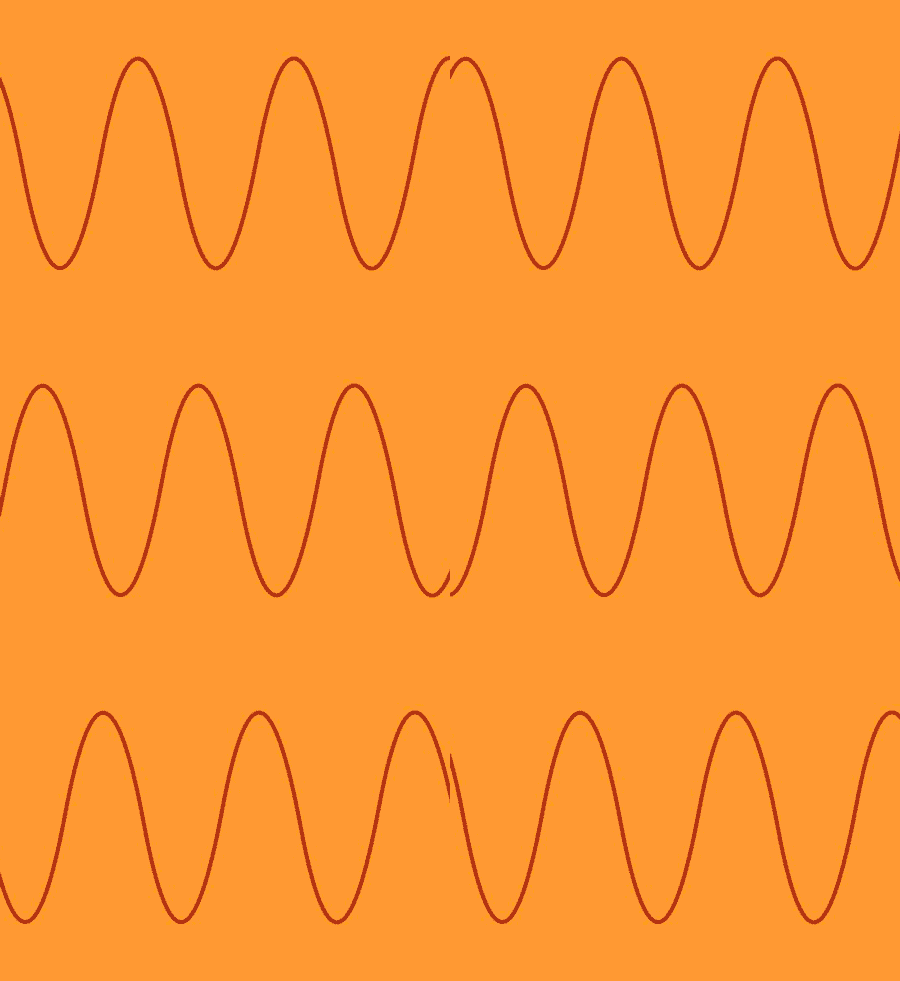
In a wave, it is very easy to find the parameters that describe a periodic phenomenon. Remember that we had to select any point and measure the time or distance to the next point with the same characteristics.

If I choose in the wave above the point of maximum amplitude of the wave, the next point with the same characteristics appears at 150 pixels (the pixel is the ideal unit of distance on a computer screen) and we can see that there is a wavenumber of 0.00667 reciprocal pixels, or what is the same, the phenomenon is repeated 6.67 times in every 1000 pixels.
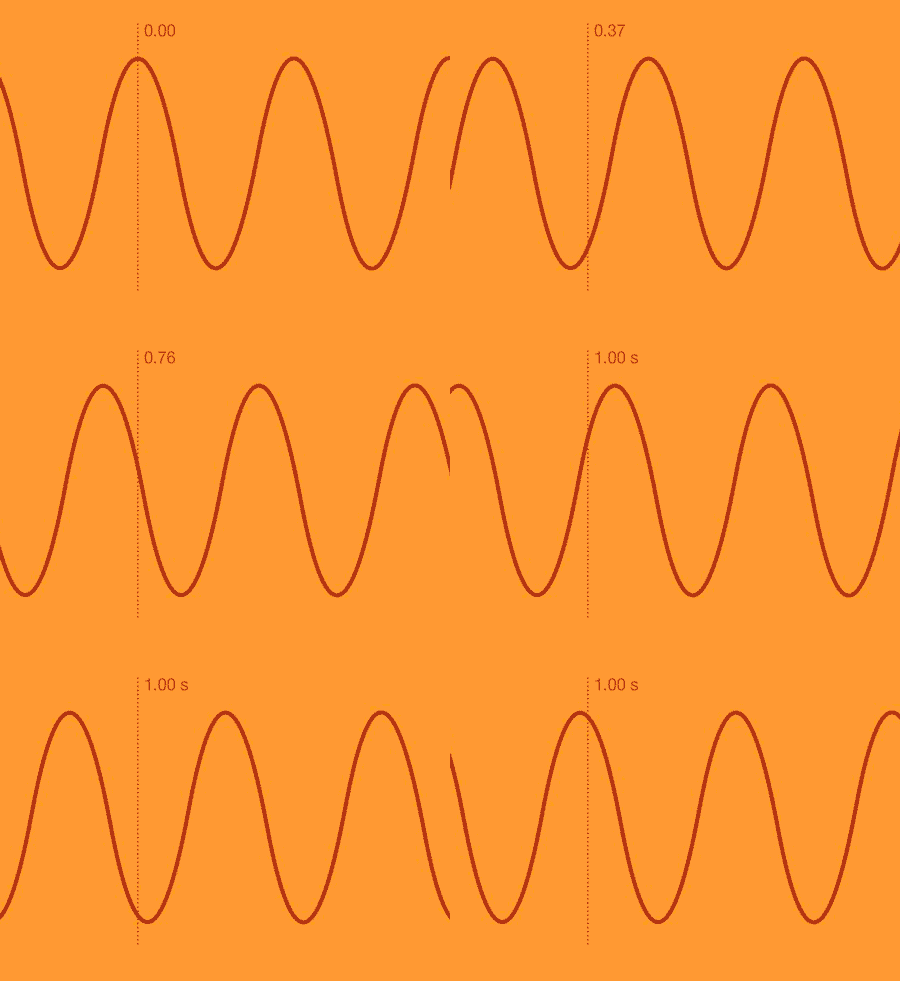
Measuring the time it takes for the wave to return to a point with the same amplitude, 1 second, we know the period, and calculating its inverse, we can see its frequency, which is 1 s-1. That is, every second we have a cycle.
Light waves belong to the group of waves that propagate through a field. I am going to quickly explain what a field is for those who do not know it. There are two ways to apply a force on something (to make it move): the first is with contact, you approach a box, put your hands on it and push it; the second is at a distance, as magnets do. This second way occurs because magnetized particles, with electric charge or with mass, generate around them a field of forces (magnetic, electric, or gravitational, respectively) that affects the particles that pass through it. The force field is like an area of influence through which if a particle passes it will suffer a force that depends on the distance to the particle that generates the field.
Generally, the intensity of fields (the intensity of the force they exert) decreases rapidly as we move away from the particle that originates them (law of universal gravitation, Coulomb's law). But when an electrically charged particle moves, it generates an oscillating electromagnetic field that travels at a speed of a billion kilometers per hour, whose intensity does not decrease with distance and which has the following appearance:

These kinds of waves, formed by two oscillations, one of an electric field and the other of a magnetic field, perpendicular to each other and, in turn, to the direction of displacement, and which do not require any material to propagate are responsible for an electron in the Sun moving electrons on Earth or for World Cup commentators to be heard via radio on the other side of the ocean. These waves are what we call light.
Light waves are known with wavelengths from 0.0003 attometers to 30 million kilometers (which is equivalent to frequencies between 1030 and 0.01 hertz), but our eyes can only detect electromagnetic waves between 400 and 750 nm, which is known as visible light. Our eyes collect light from the outside and focus it on the retina, where there are two types of cells that detect light: rods and cones.

Both cells have a mechanism that transforms light into a nerve impulse that is sent to the brain. Basically, these cells have proteins called opsins in their outer segment (outer segment in the figure above) that have a molecule called retinal attached, derived from vitamin A (vitamin A is what gives carrots their orange color, which is why it is good for eyesight to eat carrots). When an electromagnetic light wave reaches the retinal, the electric field of the wave causes the electrons of the molecule to move (the field has exerted a force at a distance), causing a radical change in the shape of the molecule that initiates a series of chain effects in the cell, which ends up sending a nerve signal to the brain indicating that it has detected light. Basically, light behaves like a mouse biting the cheese of a trap: as soon as it touches it, it releases the spring that launches the trap.
The retinal before and after being hit by light. The retinal is a molecule that behaves exactly like a mousetrap; as soon as light touches it, it snaps.
After sending the impulse, the original shape of the retinal must be recovered to continue detecting light waves (like mousetraps, after they have snapped, they must be reset). This process takes some time, which is why when we look at an intense light source, we are left seeing a strange spot for a while.
The operating principle of rods and cones is the same, but each cell has specialized in a different task. Cones measure the wavelength of the light that reaches the eyes. In humans, there are three types of cones, each with a slightly different opsin that allows them to detect a different area of the visible spectrum. The first type of opsin detects a band with a maximum at 420 nm, the second detects light around 534 nm, and the third around 564 nm. It is the information sent by these three cones that the brain interprets as colors. So, color is nothing more than the brain's interpretation of light of a certain wavelength captured by the cones of the retina. In this figure we can see which color corresponds to each wavelength:

Rods have specialized in detecting light, and the information they collect is not used by the brain to interpret colors. In their outer segment, they have a much higher concentration of opsins than cones. This allows them to work even in low light conditions, which is why when there is little light we do not distinguish the tones well, since most of the nerve impulses from the retina are being generated by the rods.
So, when we see the red color of a Spanish National Team shirt, a process is culminating that begins with the movement of a charged particle in the light source (an electron in the filament of a light bulb or on the surface of the Sun, for example), which generates an electromagnetic wave of 730 nm wavelength (the wavelength that the red color of this World Cup shirt has) that travels through space, bouncing off the shirt towards our eye, which sends it to a cone of the retina, where the electric field of the wave causes the movement of the electrons of the retinal molecule, which changes shape causing the opsin to initiate a biochemical process that ends up sending a signal to the brain that interprets the information and tells us: that shirt is red. Thanks to this process, which I hope is not so complicated after reading this entry, we have been able to follow the World Cup, without confusing the shirt of Spain with that of Brazil or that of France with that of the Netherlands. All this thanks to the properties of a periodic phenomenon such as the waves in the stadiums. In the end, everything is related.
|
Next post: Advertising Marathon 2017 |
Previous post: The Reckless Acts... When the DGT Shook Spain |